
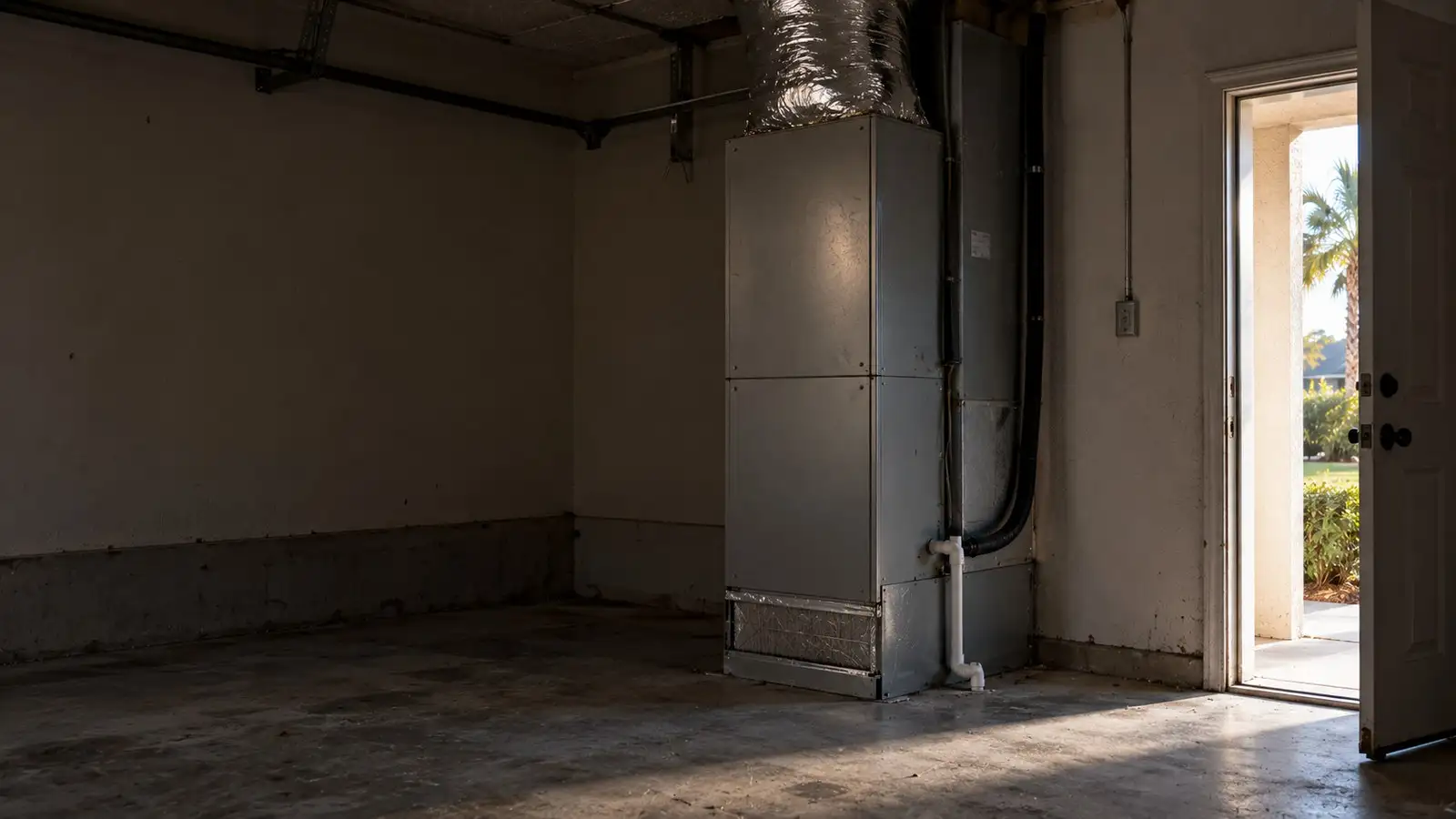
What the air handler in a Polk County house does
In a Polk County house the air handler is a cabinet in the garage or a hall closet holding three things: a blower, an evaporator coil, and in almost every case a bank of electric resistance strips for winter. Air is pulled in through the return and the filter, passed across the cold coil where it gives up both heat and moisture, and pushed out into the duct system. The condensate that comes off the coil drains away through a small pipe, and in this humidity that pipe carries gallons a day.
Because all of that happens indoors, most air handler repair in Lakeland begins with a fault mistaken for something outside. The condenser goes on running, the thermostat goes on calling, and the house simply stops cooling.
Blower motors and the airflow they are supposed to deliver
Air handler repair in Lakeland divides along one line. A blower fails in two ways: it stops, which is obvious, or it slows, which is not. Worn bearings, a weak capacitor on an older motor, or a wheel packed with dust all reduce the volume of air moving across the coil. Less airflow means the coil gets colder than it should, which drops it toward freezing, which reduces airflow further. That feedback loop is why a system can go from mildly underperforming to completely iced over in a single hot afternoon.
The measurement that catches it is static pressure across the air handler, taken with the system running. It shows the resistance the blower is working against, and it distinguishes a tired motor from a duct system that was never adequate.
The coil, the pan and the float switch
An evaporator coil in Lakeland spends nine months a year wet. It collects dust that the filter missed, and biological growth establishes in the pan and the drain line beneath it. Two consequences follow. The coil surface gradually insulates itself, so heat transfer falls without anything obviously breaking. And the drain line narrows until it backs up, filling the pan and tripping the float switch, which shuts the system down to keep water out of the ceiling.
A shut-down on a full pan is the correct behavior of a working safety device, not a failure. What matters is whether the drain is cleared or actually corrected. A line without enough slope, or a trap too shallow to hold a seal against blower pressure, will do it again every season.
The ducts attached to it
Nearly every house in this county runs its supply ducts through an unconditioned attic, which is the hottest part of the building for most of the year. Leakage there is not a small loss: air escaping into an attic is paid for twice, once to cool it and again because the return has to pull replacement air from somewhere. Older slab homes in Lakeland and Polk County add a further problem where the runs were cast into or beneath the floor, since those cannot be sealed and have often corroded from the inside.
Returns deserve the same attention and rarely get it. A single central return in a house with closed bedroom doors leaves those rooms with no path back to the air handler, and a return that uses a wall or joist cavity instead of sealed duct pulls attic air straight into the system. Both are common in the older housing across this service area, and both are cheaper to fix than to compensate for.
Air handler service by city in Polk County
- LakelandZIP 33801, 33803, 33805, 33809, 33810, 33811, 33812, 33813, 33815
- Winter HavenZIP 33880, 33881, 33884
- Plant CityZIP 33563, 33565, 33566, 33567
- Haines CityZIP 33844
- BartowZIP 33830
- AuburndaleZIP 33823
- Lakeland HighlandsZIP 33813
- Lake AlfredZIP 33850
- MulberryZIP 33860
- Polk CityZIP 33868
Frequently Asked Questions
- The outdoor unit runs but no air comes out of the vents.
- That points indoors rather than outdoors. The usual causes are a blower motor or its capacitor, a control board that has lost the fan signal, a tripped float switch under a full drain pan, or a coil so completely iced that air can no longer pass through it. All four leave the condenser running, which is why the fault looks like it must be outside when it is not.
- Why does the system keep shutting itself off with water in the pan?
- The float switch is protecting the house. Your coil is producing condensate faster than the drain is carrying it away, almost always because the line has partly blocked with biological growth. Clearing it restores operation. If it recurs every season, the fault is the geometry of the drain — insufficient slope or a trap that cannot hold a seal — and clearing it again will not fix that.
- What does static pressure tell you?
- It measures how hard the blower is having to push against the duct system, in the same way blood pressure measures resistance rather than the health of the heart. High static pressure means restriction: a blocked filter, an undersized return, a crushed flexible duct run or a coil packed with dirt. It is the most direct way to tell whether a comfort complaint is an equipment problem or a duct problem.
- Is a variable-speed blower worth it in this climate?
- It can be, because it addresses the humidity problem directly. A variable-speed blower can run long and slow, which is the condition in which a coil removes the most moisture, instead of cycling on and off at full speed. The condition is that the duct system can take it. On a house with high static pressure, the blower spends its range fighting the ducts rather than improving comfort.
- How much of the cooled air is lost in the attic?
- More than most homeowners expect. Ducts in Florida attics run through the hottest space in the building, and leakage in older systems has been measured high enough to cancel out a large share of the improvement a new system was bought for. It is worth measuring rather than assuming, because sealing is far cheaper than the equipment upgrade people usually reach for first.