
Why this is a Polk County speciality
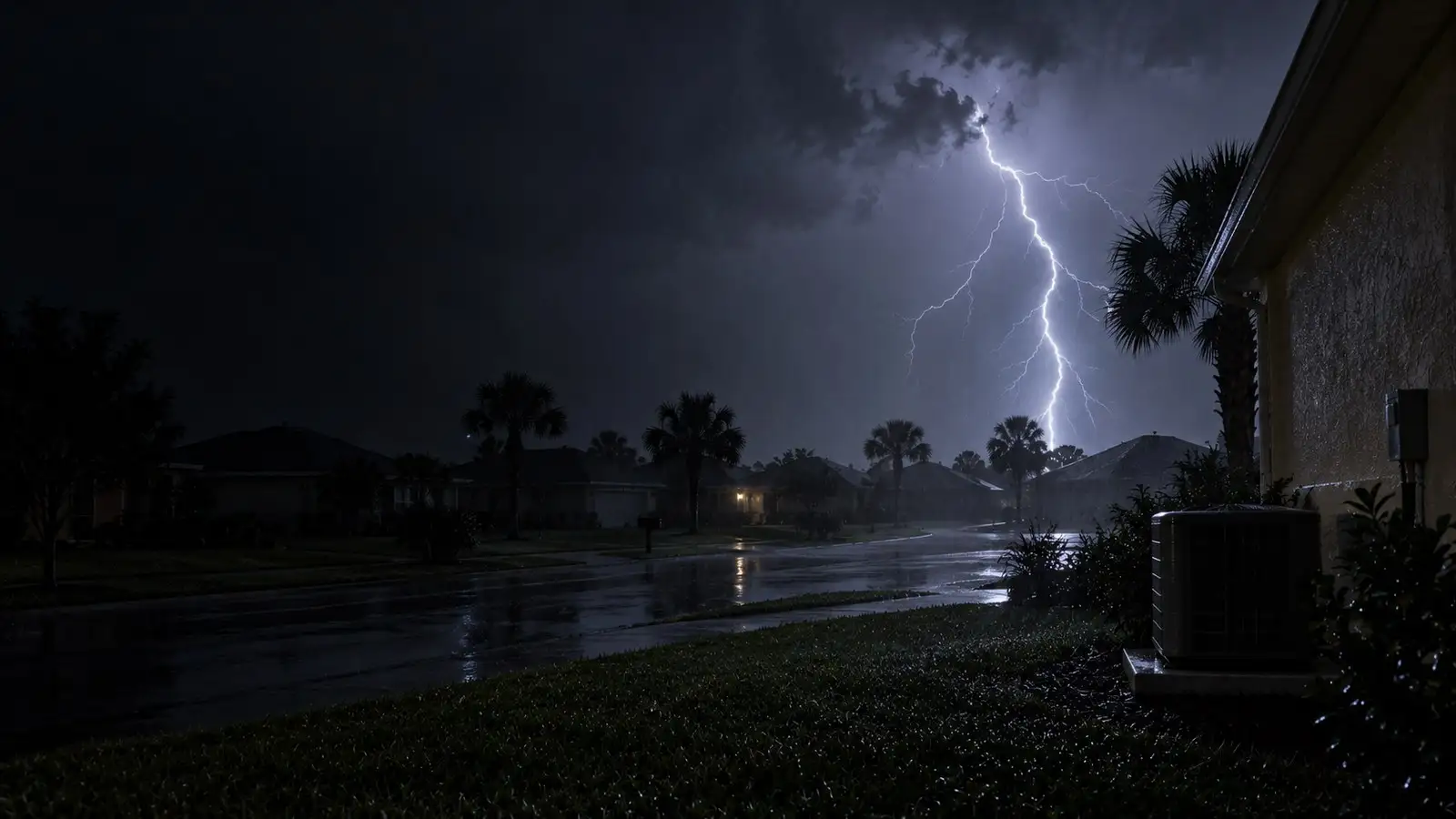
Xweather counted 1,057,635 lightning events in this county during 2025, the highest total of any county in the state. Central Florida sits between two coasts, and the sea breezes that meet over the peninsula every summer afternoon build the storms that produce those numbers. For an air conditioning system, the consequence is not that lightning strikes the house. It is that the electrical supply to a house here takes more transients in a season than it would almost anywhere else in the country.
Nearly every case that reaches a technician involves a strike somewhere else on the circuit, or the switching that follows one when the utility restores power. Whatever the source, the path is the same and it ends at the outdoor unit.
The path a surge takes into the system
The run capacitor is the first casualty because it is the most electrically exposed part in the machine. It stores and releases charge on every compressor start, and a transient either weakens it or destroys it outright. A weakened capacitor produces the classic symptom: the compressor hums, draws heavy current and does not turn, then trips out on its overload.
Next is the contactor, whose points carry the full load current. A surge can weld those points together, which leaves the compressor running continuously regardless of what the thermostat wants, or pit them badly enough that the connection fails intermittently. After that comes the low voltage control board, and only then the compressor itself.
When the compressor is the part that went
A compressor failure after a storm is the least common of the four outcomes and much the most expensive, and it is where the refrigerant transition bites hardest. Replacing a compressor on a system built for R-410A means recovering and recharging that refrigerant, and its wholesale price has moved from roughly eight to twelve dollars a pound into the twenty-five to forty-five dollar range as production allowances have stepped down.
So the same failure produces two different answers depending on the age of the equipment. On a system with years of service left, a compressor is a repair worth making. On one already past fifteen years, the compressor plus the charge frequently approaches the cost of a new system built for R-454B, and the decision changes. It is a calculation rather than an opinion, and it needs the equipment's age, its refrigerant type and the actual charge quantity in front of you.
What to do after a storm takes the power out
If you know the power is out, switch the thermostat off. When supply returns it comes back to the whole circuit at once, and a compressor asked to start immediately, against pressure that has not yet equalised, draws locked-rotor current until something gives. Leaving the system off for a few minutes after power returns removes that risk entirely and costs nothing.
If a breaker trips, reset it once. If it trips a second time, leave it off and say so when you call: something downstream is drawing current it should not, and repeated resets add damage. And if the system appears to survive the storm, stay alert for a few days. Degraded parts commonly fail on the first hot afternoon that follows rather than during the weather itself.
Protecting the equipment against the next one
Surge protection for air conditioning is normally installed in two layers. A protector at the electrical panel intercepts what arrives down the service conductors and protects everything in the house. A second, dedicated device at the outdoor unit's disconnect sits directly in front of the equipment that a surge reaches first. Neither stops a direct strike on the structure, and neither should be sold as doing so. Against the nearby strikes and switching transients that cause the great majority of damage in Polk County, the pair is a reasonable and inexpensive precaution.
Storm damage AC repair by city in Polk County
- LakelandZIP 33801, 33803, 33805, 33809, 33810, 33811, 33812, 33813, 33815
- Winter HavenZIP 33880, 33881, 33884
- Plant CityZIP 33563, 33565, 33566, 33567
- Haines CityZIP 33844
- BartowZIP 33830
- AuburndaleZIP 33823
- Lakeland HighlandsZIP 33813
- Lake AlfredZIP 33850
- MulberryZIP 33860
- Polk CityZIP 33868
Frequently Asked Questions
- My AC stopped after a storm. What is the likely fault?
- In this county the order is consistent: the run capacitor first, then the contactor, then the low voltage control board, and only in the worst case the compressor. A capacitor is a small part and a short visit. A welded contactor is similar. A board is more expensive but still a repair. The compressor is where the conversation turns into one about the whole system, and it is the least common of the four.
- Does lightning have to hit the house to damage the air conditioner?
- No, and it usually does not. Most surge damage in Polk County comes from strikes into distribution lines somewhere else on the circuit, or from the switching that restores power afterwards. The spike reaches your outdoor unit along the same conductors that normally feed it. That is why damage often appears at several houses on a street at once, none of which were struck.
- Will a surge protector actually prevent this?
- It reduces the risk rather than eliminating it. The usual recommendation is layered: a protector at the electrical panel to catch what comes down the service, and a dedicated one at the outdoor unit's disconnect to protect the equipment specifically. Neither will stop a direct strike. Both meaningfully improve the odds against the far more common case of a nearby strike or a switching transient.
- The system worked after the storm and failed two days later.
- That sequence is common and it is not a coincidence. A surge can damage a capacitor or pit a contactor without stopping the system on the spot. The equipment runs on in a degraded state and then fails when the next hot afternoon asks it for full current. If there was an outage in the last few days, say so when you call, because it directs the diagnosis at the electrical side first.
- Would homeowners insurance cover a lightning-damaged compressor?
- Sudden damage from lightning is a covered peril on many policies, while wear and gradual failure is not, so the distinction matters and it is made on evidence. Photograph the equipment, keep the failed parts, note the date and time of the storm or outage, and ask the contractor for written findings that identify the failure mode. Whether a specific claim is paid is between you and your insurer.