
One machine, two directions
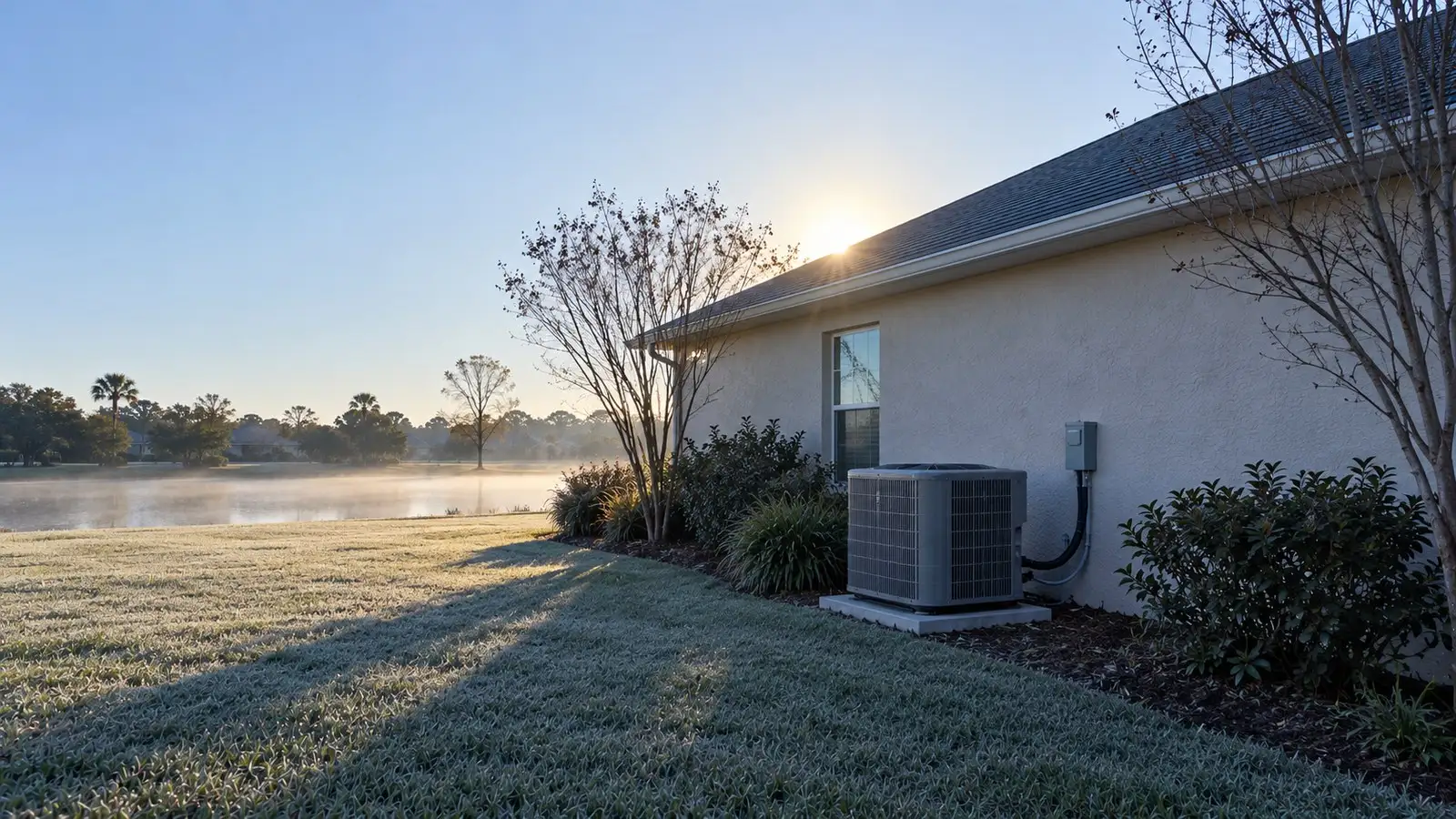
Ninety-three per cent of occupied homes in Polk County heat with electricity, and almost none of them have a furnace. Heat comes from reversing the same equipment that cooled the house in August: a valve changes the direction refrigerant travels, the outdoor coil becomes the evaporator and the indoor coil becomes the condenser. Everything else — compressor, blower, ducts, thermostat — is unchanged, which is why a heat pump fault in December often turns out to have been visible in July.
What fails on a Polk County heat pump, and when
Heat pump repair in Lakeland divides into two lists. The parts unique to heating are the reversing valve, its solenoid coil and the defrost control board. In this climate they sit unused from March to November, and the failure is almost always discovered on the first genuinely cold night rather than gradually. The classic Lakeland call is a system that cooled perfectly all summer and produces nothing but strip heat the first time the thermostat asks for warmth.
The parts shared with cooling fail on their own schedule. A run capacitor that has dried out, a contactor with pitted points, a low charge from a slow leak: each of them degrades heating and cooling together, but the effect is easier to miss in winter because the strips quietly cover the shortfall. That is the practical reason to watch the electricity bill as a diagnostic instrument in January.
Strip heat and the cold-snap bill
Auxiliary heat is a bank of resistance elements in the air handler. It is meant to supplement the heat pump during the coldest hours and during recovery from a setback, and it uses two to three times the electricity for the same amount of warmth. On the fronts that reach Polk County and drop the overnight temperature into the thirties, running on strips for several nights is normal and expected.
Running on strips in mild weather is not. If the thermostat shows auxiliary or emergency heat when it is 55 degrees outside, the heat pump side is not doing its share, and the house is being warmed the expensive way. Amp readings at the air handler and at the outdoor unit separate the possibilities in a few minutes: a heat pump that is not running at all, one that is running without moving heat, or a control that is calling for strips when it should not be.
Defrost, and why it looks like a fault
On a damp morning near freezing, the outdoor coil of a heat pump can frost over, and the system briefly reverses to melt it. During that cycle the outdoor unit steams, the indoor blower may pause and the strips may come on for a few minutes. It looks alarming and it is normal. What is not normal is a unit that stays iced, or one that defrosts every fifteen minutes, and both point at the defrost control or at airflow across the outdoor coil.
Getting ahead of the first cold night
The most useful thing a homeowner can do, and the one that avoids a heat pump repair in Lakeland at two in the morning, is to switch the thermostat to heat for ten minutes in October, before anyone needs it. If the outdoor unit runs and the air from the registers is warm without the strips being called, the heating side is intact. If nothing happens, or if the only heat is coming from the strips, that is a problem worth solving in mild weather rather than at two in the morning during a freeze.
Heat pump service by city in Polk County
- LakelandZIP 33801, 33803, 33805, 33809, 33810, 33811, 33812, 33813, 33815
- Winter HavenZIP 33880, 33881, 33884
- Plant CityZIP 33563, 33565, 33566, 33567
- Haines CityZIP 33844
- BartowZIP 33830
- AuburndaleZIP 33823
- Lakeland HighlandsZIP 33813
- Lake AlfredZIP 33850
- MulberryZIP 33860
- Polk CityZIP 33868
Frequently Asked Questions
- What is auxiliary heat and why does it cost so much?
- Auxiliary heat is a bank of electric resistance elements in the air handler that switches on when the heat pump alone cannot keep up, typically below about 40 degrees or when the thermostat is jumped several degrees at once. Resistance heat uses two to three times the electricity a heat pump uses for the same warmth. A five-day cold snap carried on strips is what turns a normal January bill into an alarming one.
- The thermostat says AUX or EM HEAT all the time. Is that a fault?
- Constant auxiliary heat on a mild Polk County morning is a symptom, not normal operation. It usually means the heat pump side is not contributing: a failed reversing valve, a refrigerant leak, a defrost board stuck in the wrong state, or a compressor that is not starting. The house still gets warm, which is why the fault is often only discovered when the power bill arrives.
- Why did my heat pump fail on the first cold night of the year?
- Because the components that only run in heating mode had not moved since the previous winter. The reversing valve, its solenoid and the defrost control sit idle for eight or nine months in this climate, and idle parts are the ones that fail on demand. Running the system in heating mode for a few minutes in October is the simplest way to find that out at a convenient moment.
- Do heat pumps work in Florida cold snaps?
- Yes, and they do most of the work. Polk County winters average a January low near 51 degrees, well inside the range where a heat pump is efficient. The strips exist for the handful of nights that go much lower and for recovery when a house has been left unheated. A system that needs the strips in ordinary weather has something wrong with it.
- Is a heat pump the same machine as my air conditioner?
- In this county it usually is exactly the same machine. A heat pump is an air conditioner with a valve that reverses the direction the refrigerant travels, so in summer it moves heat out of the house and in winter it moves heat into it. That is why ninety-three per cent of Polk County homes heat with electricity and almost none of them have a furnace.