
Air conditioning repair in Polk City, FL
Polk City sits north of Interstate 4 beside Lake Agnes, at the southern edge of the Green Swamp. It is the wettest surrounding landscape in this service area: a large protected recharge area of cypress and marsh that keeps humidity high and overnight dew points close to the air temperature well into the autumn. The Van Fleet Trail runs north out of town along the old rail bed.
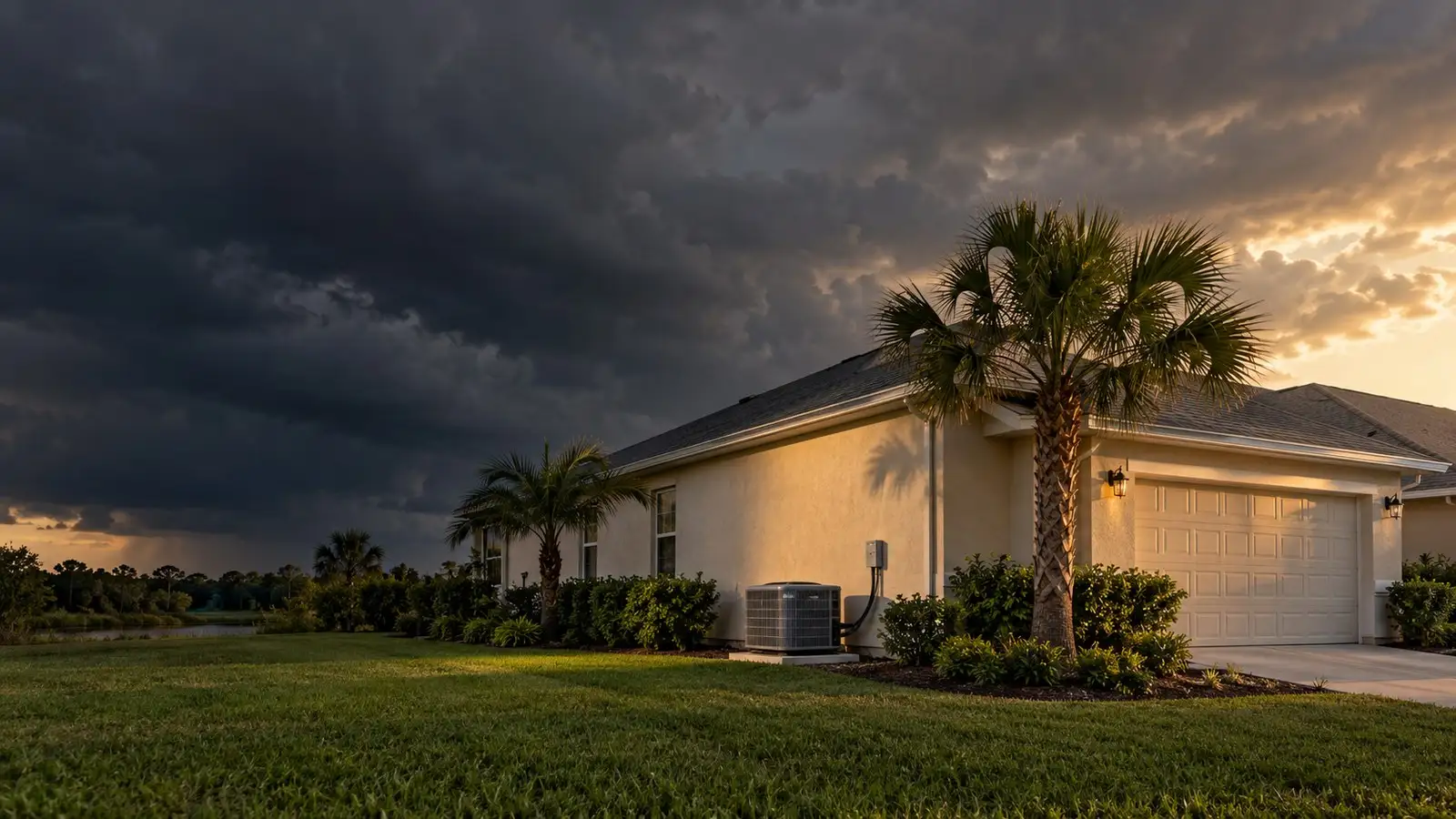
At a median build year of 2007, Polk City has the newest housing on this site, and eighty-three per cent of it is owner-occupied. Most of the town is single-family construction from the two decades either side of that date, built to modern Florida practice with a tight envelope, a slab, a garage air handler and flexible duct in the attic. Very little of the older Florida pattern survives here.
First checks in Polk City
- Both breakers — air handler and outdoor unit — plus the pull-out disconnect beside the condenser.
- The filter, held up to the light. Blocked filters freeze coils.
- The copper line into the outdoor unit. If it has ice on it, switch the system off and leave it off.
AC repair Polk City, FL: what actually fails
First failures on 2000s equipment
A system installed with a 2007 house has passed the twelve to fifteen years a split system gives in this climate. Original builder equipment across the town is reaching that point together: capacitors that have dried out, contactors with pitted points, blower motors with worn bearings. These are repairs rather than replacements, but they arrive in clusters after two decades of nothing at all.
Swamp-edge humidity
The Green Swamp holds moisture in the air overnight, so the system runs against a higher latent load than it would in the drier ridge towns. That produces more condensate, which loads the drain harder, and it makes a slightly oversized system feel worse here than the same unit would feel elsewhere. Run time matters more than capacity on this side of the interstate.
Flexible duct that has moved
Attic ducts in houses of this generation are flexible rather than rigid, supported on straps across the trusses. Over twenty years straps slip, runs sag into long low points and stored boxes crush sections nobody sees. Each of those adds resistance the blower has to overcome, and it usually shows first as one room that stopped keeping up several summers ago.
Long rural feeders and slow restoration
North Polk is served across open and wooded country, and a storm that takes down a line here is not the first one Duke restores. Equipment sits without power for longer, and then everything on the circuit restarts at the same moment when it returns. That simultaneous restart is where hard-start components and contactors fail, hours after the weather has cleared.
How an HVAC system in a Polk City house is put together
Heat pump repair and heating in Polk City
The heat pumps in these houses are modern enough to carry most of a Polk County winter without help, and their strips are there for the rare morning that drops toward freezing. What that means practically is that a strip failure can go unnoticed for two or three winters, because nothing calls on it. The first cold snap that does is when a burnt element or a failed sequencer turns up, usually at the worst possible hour.
AC replacement and repair services in Polk City
- AC Replacement & New System InstallationSized by a load calculation on the house, not by whatever came out of it.
- Heat Pump Repair & ServiceOne machine for both seasons: reversing valve, defrost and the strip heat behind it.
- Air Handler & Blower RepairBlower, evaporator coil, drain pan and the attic duct run attached to them.
- Lightning & Power Surge AC RepairCapacitor, contactor, board and compressor after a strike or a grid surge.
Areas covered in Polk City
AC repair in Polk City runs across the city and the streets around it, including Lake Agnes, Mount Olive, Fountain Park, Bridgewater, Lake Mattie, the Berkley Road corridor, Van Fleet Trail, Auburndale Road and Commonwealth Avenue.
ZIP codes: 33868. Power here comes from Duke Energy Florida.
Frequently Asked Questions
- My house is newer than most. Why is anything failing already?
- Because equipment ages on its own schedule rather than the building's. Twelve to fifteen years is the working life of a split system in central Florida, and a 2007 house on its original unit is past that. Capacitors, contactors and blower motors are the parts that go first, and they are repairs rather than replacements. The compressor is the part that decides whether the system has a future.
- Is the Green Swamp actually making my house more humid?
- Indirectly, yes. A large marsh and cypress area holds moisture in the air overnight, so the outdoor dew point stays higher longer than it does on the ridge. Your system therefore has more water to remove for the same temperature drop, which means longer run times are useful rather than a symptom of a fault. A system that reaches setpoint in seven minutes will leave the house feeling damp.
- The heat has not been needed in years. Should it be checked?
- Yes, and before it is needed rather than during the first cold night. Strip heaters, sequencers and the reversing valve all sit unused for most of the year, and unused parts are the ones that fail on demand. Running the system in heating mode for a few minutes in the autumn is the simplest way to find out whether anything has quietly stopped working.
- How long does it take a technician to get out here?
- Polk City is off the interstate about fifteen miles from Lakeland, so it is inside the working area rather than at its edge, but it is a smaller town with fewer companies based in it. Availability depends on the provider and on how the day is running rather than on distance alone, and after a widespread storm the whole county competes for the same crews.
- Who would actually come out to my Polk City address?
- An independent heating and air conditioning company working in the north Polk County edge of the Green Swamp. AC Repair Lakeland employs no technicians and does no work itself. Florida licenses air conditioning contractors through the state Construction Industry Licensing Board, and a license can be checked by name or number first.